
Architecture Environments
D5.1 organises MaaSAI into three operational environments. Together, they describe how the platform supports discovery, planning, negotiation, execution, monitoring, and secure data exchange across the ecosystem.
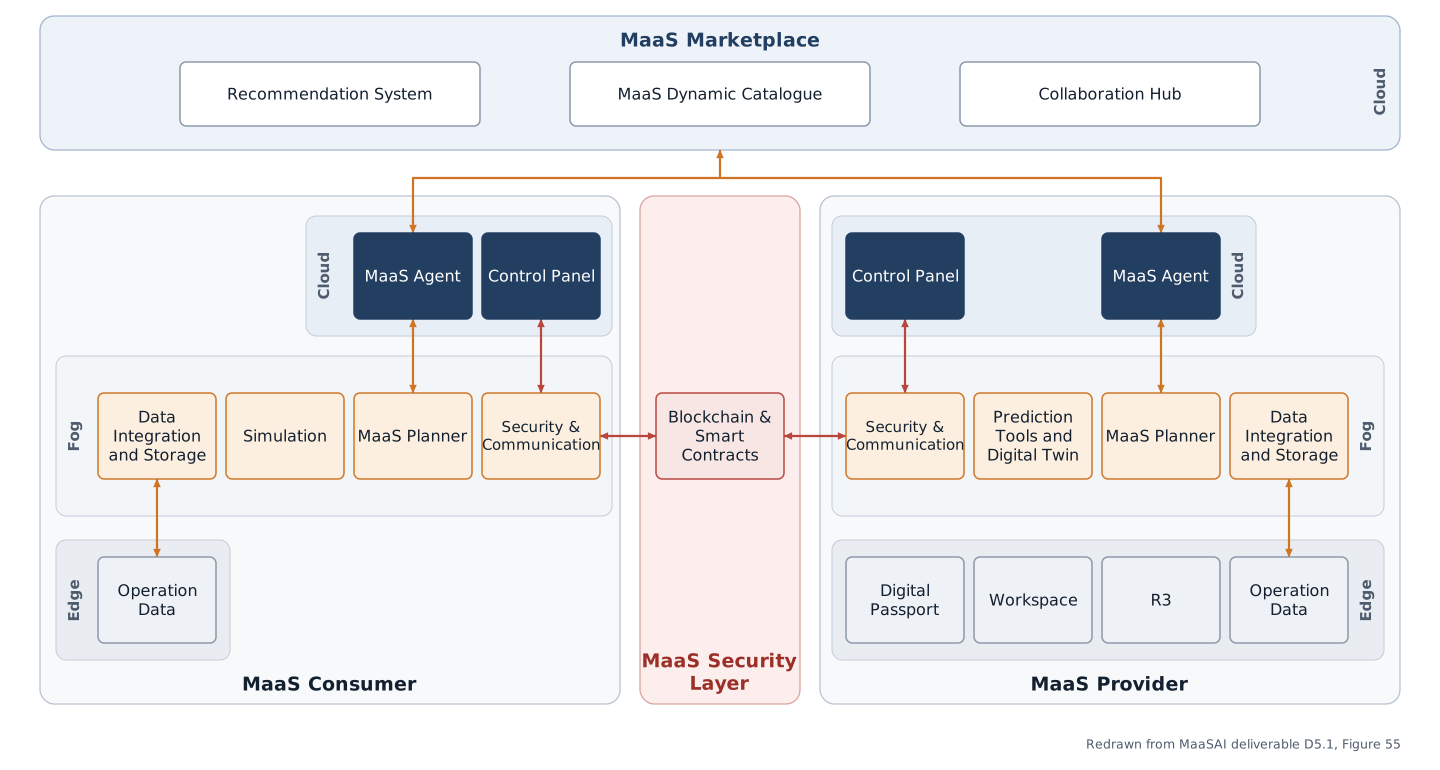
Simplified functional architecture redrawn from MaaSAI deliverable D5.1.
Cloud MaaS Marketplace Environment
Section titled “Cloud MaaS Marketplace Environment”This environment is the shared cloud entry point of MaaSAI. It supports onboarding, catalogue publication, provider discovery, recommendation, and structured collaboration between organisations.
Main solutions
Section titled “Main solutions”- Cloud MaaS Marketplace (CMM)
- MaaS Dynamic Catalogue (MDC)
- Recommendation System (RS)
- MaaS Collaboration Hub (MCH)
Architectural characteristics
Section titled “Architectural characteristics”- Cloud-native and microservice-oriented deployment.
- Dedicated APIs between components, with documented payloads and controlled interfaces.
- Centralised security patterns such as authentication, authorisation, Single Sign-On, and token-based API access.
- Dedicated persistence per component and monitored health endpoints for operational resilience.
MaaS Consumer Environment
Section titled “MaaS Consumer Environment”This environment supports companies that consume manufacturing services. It connects enterprise systems, planning logic, negotiation automation, simulation, and trusted contracting before work is handed to providers.
Main solutions
Section titled “Main solutions”- MaaS Consumer Agent (MCA)
- MaaS Consumer Planner (MCP)
- MaaS Supply Chain Simulator (SCS)
- Remote Monitoring and Control (RMC), reserved for MaaS Consumers to follow production at the provider (D10.1)
- Data Integrator (DI)
- EDGE Data Storage (DS)
- Smart Contracts Toolkit (SCT)
- MaaS Blockchain (MSB)
- Point-to-Point Secure Messaging (PSM)
- Control Panels (CP)
Architectural characteristics
Section titled “Architectural characteristics”- Tight coupling with ERP and MES information through integration and edge storage services.
- Planning and negotiation capabilities supported by consumer-side agents and simulation components.
- Secure contracting and traceability through blockchain-enabled services.
- Edge and fog processing to keep operational data close to the source while still interacting with cloud services.
MaaS Provider Environment
Section titled “MaaS Provider Environment”This environment supports companies that offer manufacturing services. It combines execution planning, analytics, lifecycle and sustainability tooling, monitoring, and trusted data exposure toward the MaaSAI marketplace.
Main solutions
Section titled “Main solutions”- MaaS Provider Agent (MPA)
- MaaS Provider Planner (MPP)
- Data Analytics (DA)
- Digital Twins Designer (DTD)
- LCA-LCC Toolkit (LCT)
- MaaS Workspace Configurator (MWC)
- Predictive Maintenance Toolkit (PMT)
- Repair-Reuse-Recycle Toolkit (R3T)
- Digital Industrial Passport Designer (DIP)
- Shared infrastructure solutions such as DI, DS, MSB, SCT, PSM, and CP
Architectural characteristics
Section titled “Architectural characteristics”- Strong interaction with shop-floor, planning, and monitoring data.
- Support for analytics, simulation, digital twin design, and sustainability assessment.
- Secure exposure of provider capabilities and contract-relevant information to the MaaSAI ecosystem.
- Interoperable data flows across analytics, planning, monitoring, and collaboration services.