
MaaS Blockchain (MSB)
At a Glance
Section titled “At a Glance”
- Category: Data & Infrastructure
- Primary environment: MaaS Consumer, MaaS Provider
- Documentation focus: Design reference
- Maturity: No TRL stated; reported as operational (first release, reported in D8.1 at M20; MaaSAI System 1st Release planned for M24)
- Related architecture docs: Reference Architecture Guide, Environments
Purpose
Section titled “Purpose”MaaS Blockchain (MSB) provides the trust layer of the MaaSAI platform. It is designed as a private Ethereum-compatible network that records transactions, supports smart contracts, and preserves traceability across provider-consumer interactions without relying on a single central authority.
Primary Actors
Section titled “Primary Actors”The D5.2 usage viewpoint defines roles, permissions, constraints, a role-task matrix, and a use case diagram for this solution.
- Regular User: View blockchain transactions, complete blockchain transactions; constraint: Limited to their own transactions
- Power User: Manages transaction flow; constraint: Cannot modify administrative settings
- Administrator: Oversees system governance, access control, and data integrity, these responsibilities become available via the SCT
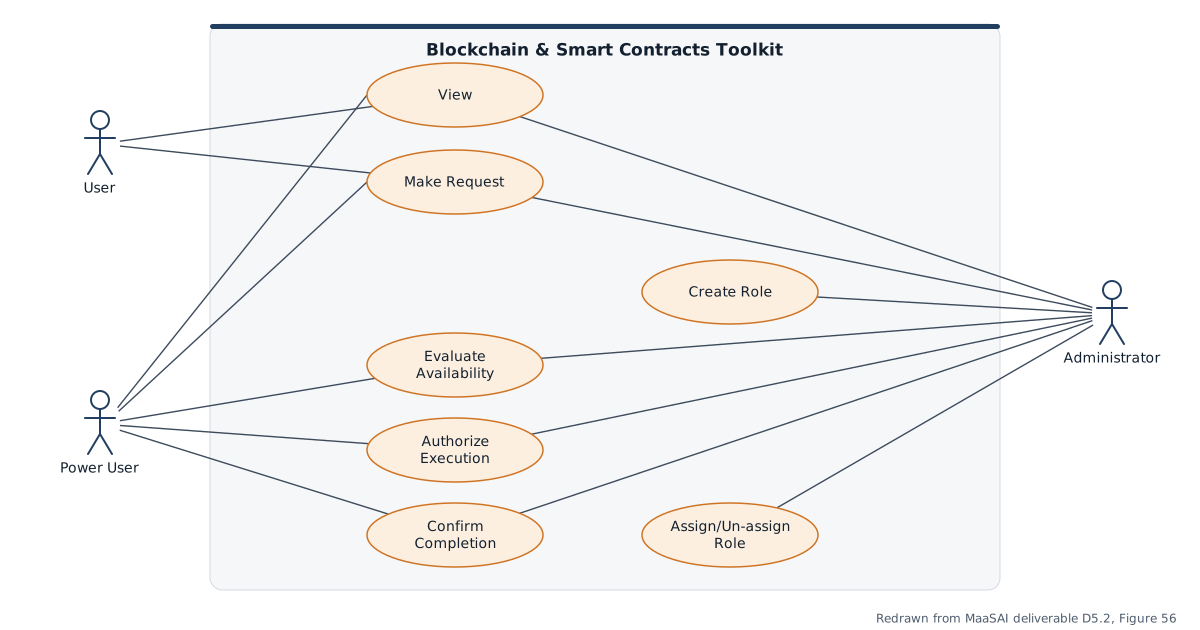
Shared blockchain toolkit use-case diagram redrawn from MaaSAI deliverable D5.2.
Functional Components
Section titled “Functional Components”MSB combines blockchain APIs, nodes, consensus services, wallet interactions, and explorer support to maintain a shared tamper-evident transaction layer. The functional view shows how external APIs reach application logic through the blockchain trust layer that anchors other MaaSAI solutions.
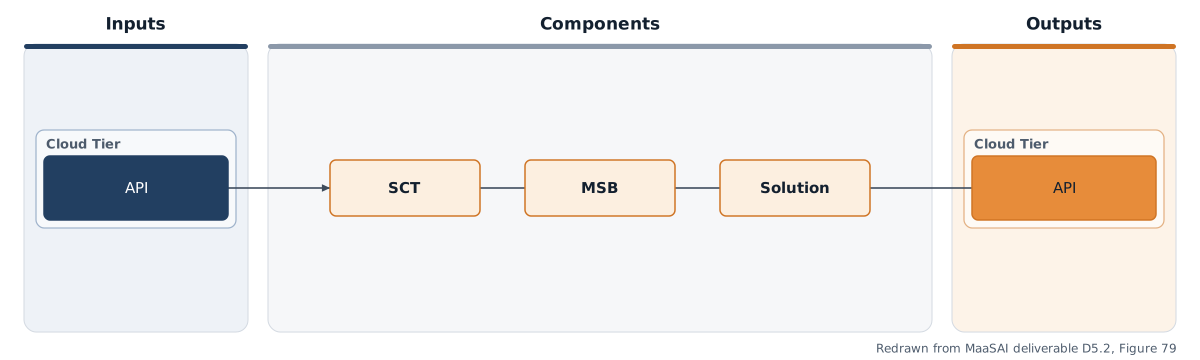
Shared blockchain interaction diagram redrawn from MaaSAI deliverable D5.2. D5.2 uses the same figure for the Smart Contracts Toolkit (Figures 75 and 79).
Design Baseline
Section titled “Design Baseline”MSB uses a permissioned blockchain model with Proof of Authority (PoA), which is a good fit for a consortium setting where trusted participants need fast transaction finality and controlled governance.
Interaction with the chain is exposed through APIs such as JSON-RPC or WebSocket, so MaaSAI services can deploy contracts, query state, and record relevant events programmatically.
Digital wallets provide the user-facing trust anchor by storing keys and signing transactions, while explorer tools give administrators and stakeholders a readable view of chain activity, contracts, and transaction history.
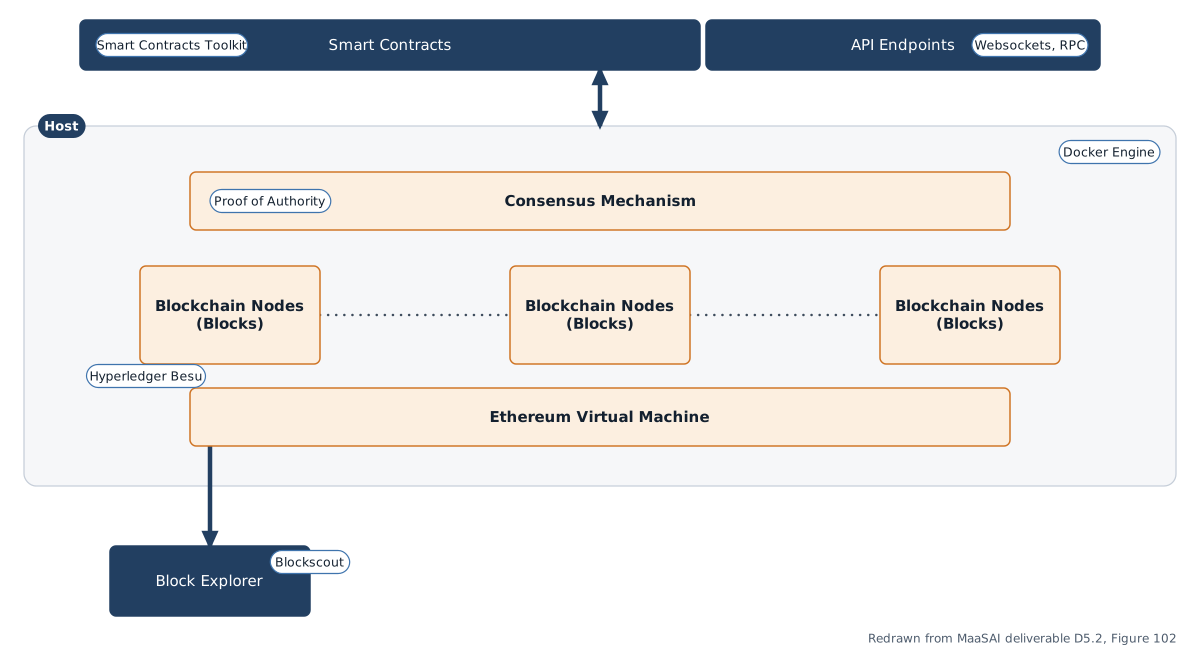
Architecture diagram redrawn from MaaSAI deliverable D5.2.
Technology Stack
Section titled “Technology Stack”The MSB is built on enterprise-grade, Ethereum-compatible open-source tooling.
| Category | Technology |
|---|---|
| Blockchain client | Hyperledger Besu, an open-source Ethereum client developed under the Linux Foundation, hosting the permissioned ledger. |
| Consensus | Proof of Authority (PoA) — lightweight, deterministic block validation by pre-approved validator nodes. |
| Smart contract runtime | Ethereum Virtual Machine (EVM), executing Solidity-compiled bytecode on-chain. |
| External interface | standard Ethereum JSON-RPC for transaction submission and on-chain state queries. |
| Explorers | BlockScout for transaction and contract visibility; Hyperledger Block Explorer for node-level network monitoring. |
Integrations & External Dependencies
Section titled “Integrations & External Dependencies”The MSB’s primary consumer is the Smart Contracts Toolkit (SCT), which submits signed transactions and queries on-chain state through the exposed RPC node on behalf of the platform; the network was deliberately configured for full Solidity compatibility so the SCT contract suite runs without additional translation layers. Agreements concluded in the marketplace reach the MSB through the SCT: the Cloud MaaS Marketplace (CMM) passes finalised agreements to the SCT, which records them as transactions on the MSB (D12.1). The infrastructure is hosted and managed by SLG on cloud servers, so consuming components need no local blockchain installation.
APIs & Interfaces
Section titled “APIs & Interfaces”- An Ethereum-compatible JSON-RPC endpoint, exposed over cloud-hosted HTTPS, is the sole programmatic interface for submitting transactions and querying contract state.
- The MSB exposes no direct user-facing interface: end users and platform operators interact with the chain exclusively through the SCT.
- BlockScout provides a web UI and API covering transactions, blocks, addresses and contract interactions.
- The Hyperledger Block Explorer offers node-level monitoring of network health, peer status and block data, intended for operational oversight and diagnostics rather than day-to-day platform use.
User Interface
Section titled “User Interface”Blockchain activity can be inspected through the network explorers:
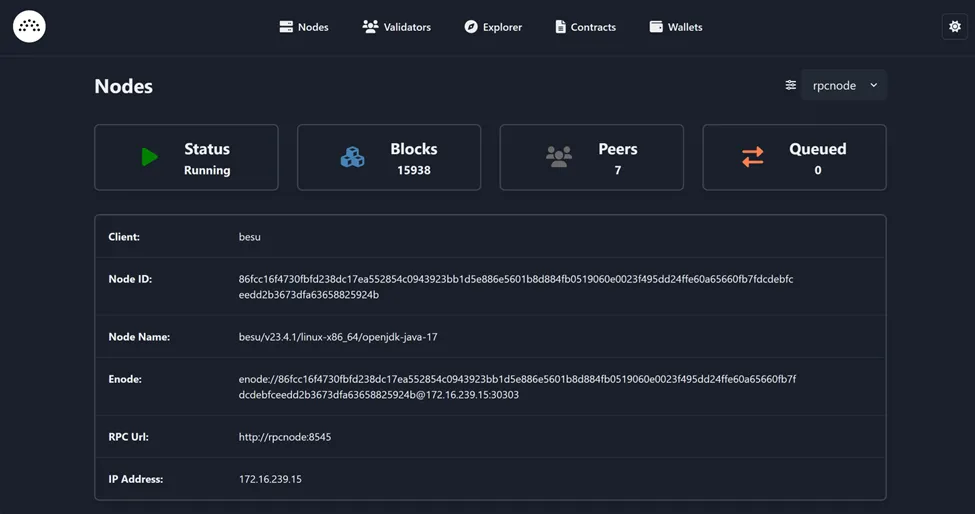
Quorum Block Explorer — MaaSAI deliverable D8.1.
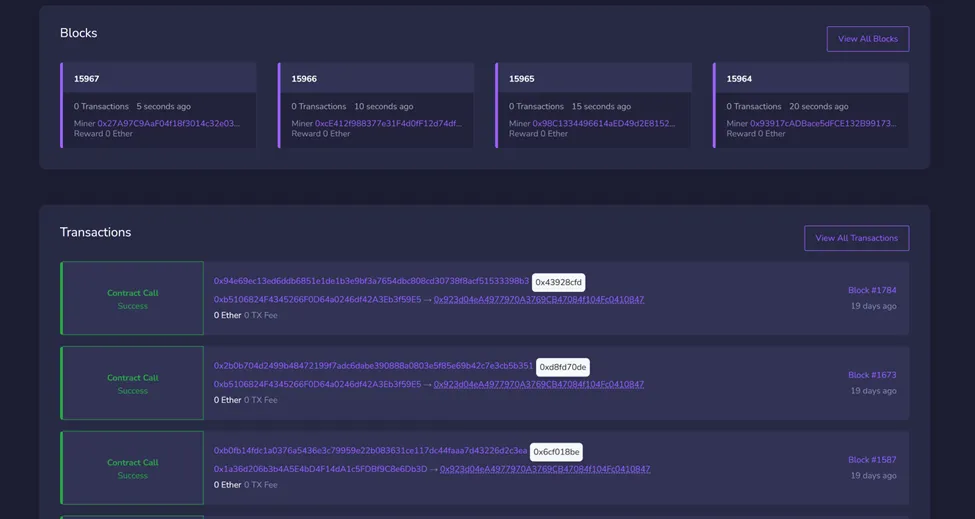
BlockScout implementation — MaaSAI deliverable D8.1.
Deployment & Configuration
Section titled “Deployment & Configuration”The MaaS Blockchain is deployed on SLG-managed infrastructure and accessed remotely via cloud-hosted HTTPS RPC endpoints; no local blockchain installation is required by any consuming component. Each network node runs on a server with the following specification:
| Requirement | Specification |
|---|---|
| OS | Ubuntu Linux 20.04.5 |
| CPU | 4 vCPUs |
| RAM | 8 GB |
| Storage | 500 GB |