
MaaS Workspace Configurator (MWC)
At a Glance
Section titled “At a Glance”
- Category: Planning, Design & Assessment
- Primary environment: MaaS Provider
- Documentation focus: Design reference
- Maturity: Approximately TRL 4 (first release, reported in D10.1 at M20; MaaSAI System 1st Release planned for M24)
- Related architecture docs: Reference Architecture Guide, Environments
Purpose
Section titled “Purpose”The MaaS Workspace Configurator (MWC) provides autonomous workspace configuration and optimisation capabilities for MaaS Providers. It processes booking information, equipment states, and operational constraints to generate suitable workspace setups for upcoming manufacturing services.
Primary Actors
Section titled “Primary Actors”The D5.2 usage viewpoint defines roles, permissions, constraints, a role-task matrix, and a use case diagram for this solution.
- MaaS Provider: Launch workspace configuration, review suggestions, override proposed configurations, and monitor execution status; constraint: Cannot modify optimisation algorithms or booking data.
- MWC Agent: Retrieve bookings, query the digital twin for resource availability, and run configuration optimisation; constraint: Operates through APIs only.
- Administrator: Manage user accounts, permissions, and logs; constraint: Cannot modify the optimisation or configuration logic itself.
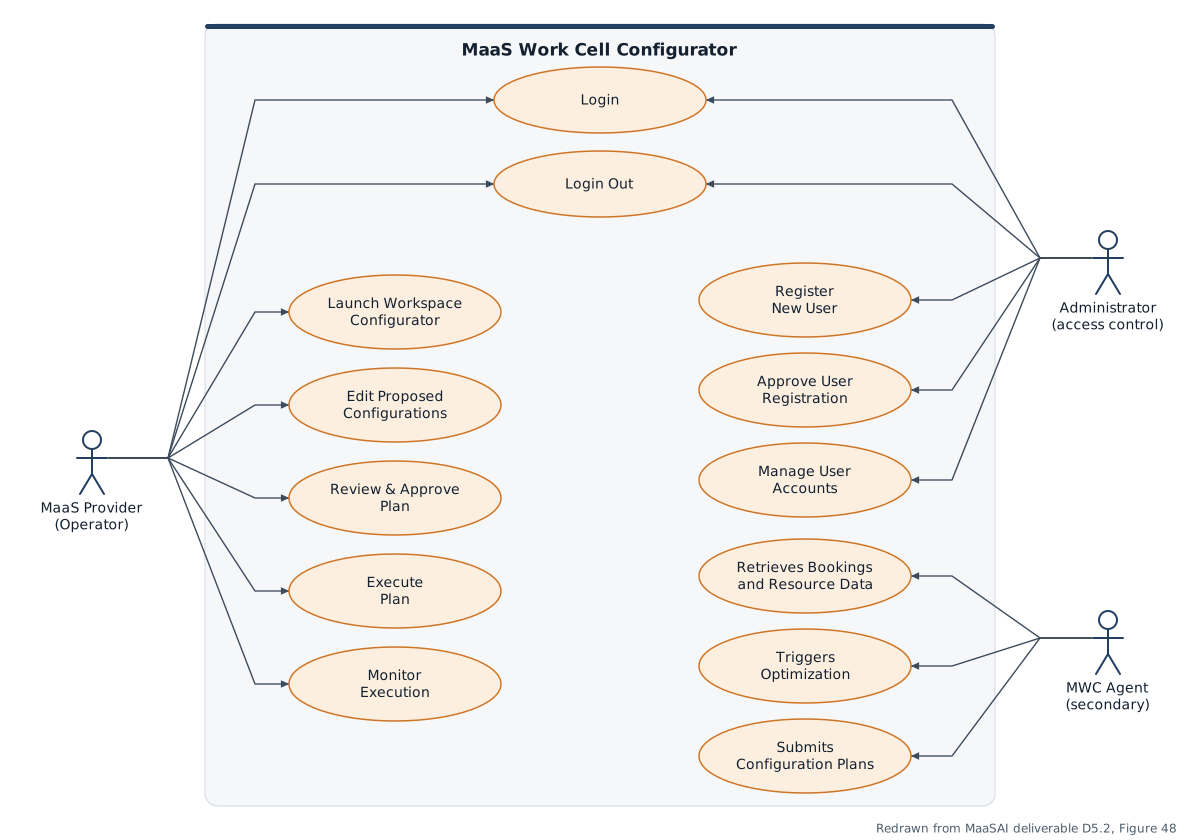
Use-case diagram redrawn from MaaSAI deliverable D5.2.
Functional Components
Section titled “Functional Components”MWC combines a configuration manager, booking integration, digital-twin inputs, optimisation, dispatching, logging, and notification services. The functional view shows how workspace configuration requests become booking updates, execution commands, and traceable operational feedback.
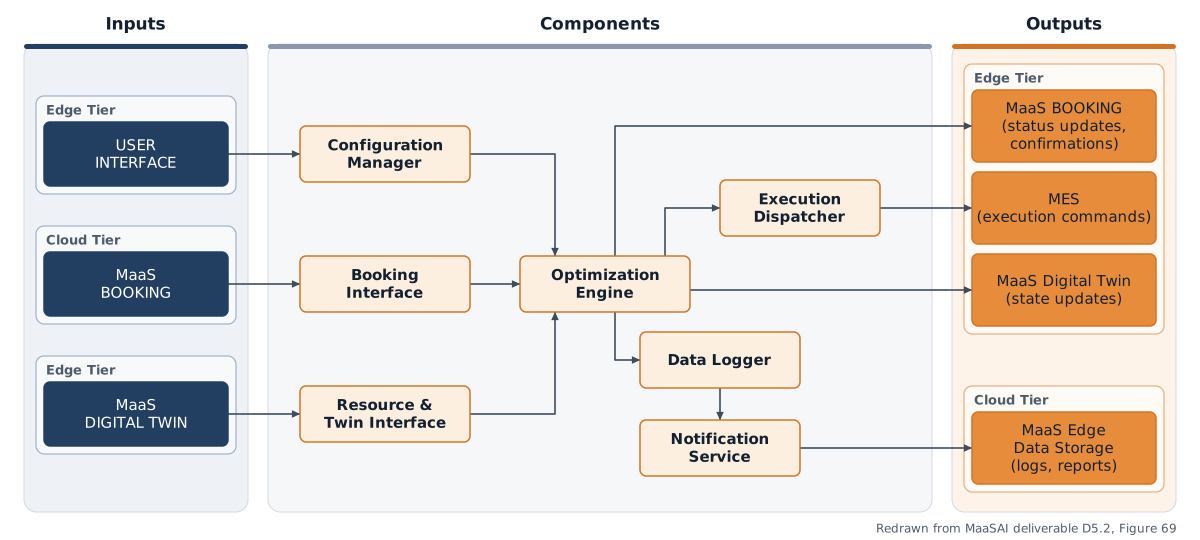
Functional components diagram redrawn from MaaSAI deliverable D5.2.
Design Baseline
Section titled “Design Baseline”The solution combines a provider-facing dashboard, a backend service layer, and persistent storage for configuration plans, booking data, resource states, and execution logs.
Its implementation architecture emphasises interoperability with other MaaSAI components, especially booking, MES, digital-twin, and edge data services.
In deployment terms, the MWC is described as a Dockerised set of modular services that communicate through well-defined interfaces, which keeps the solution adaptable across different provider environments.
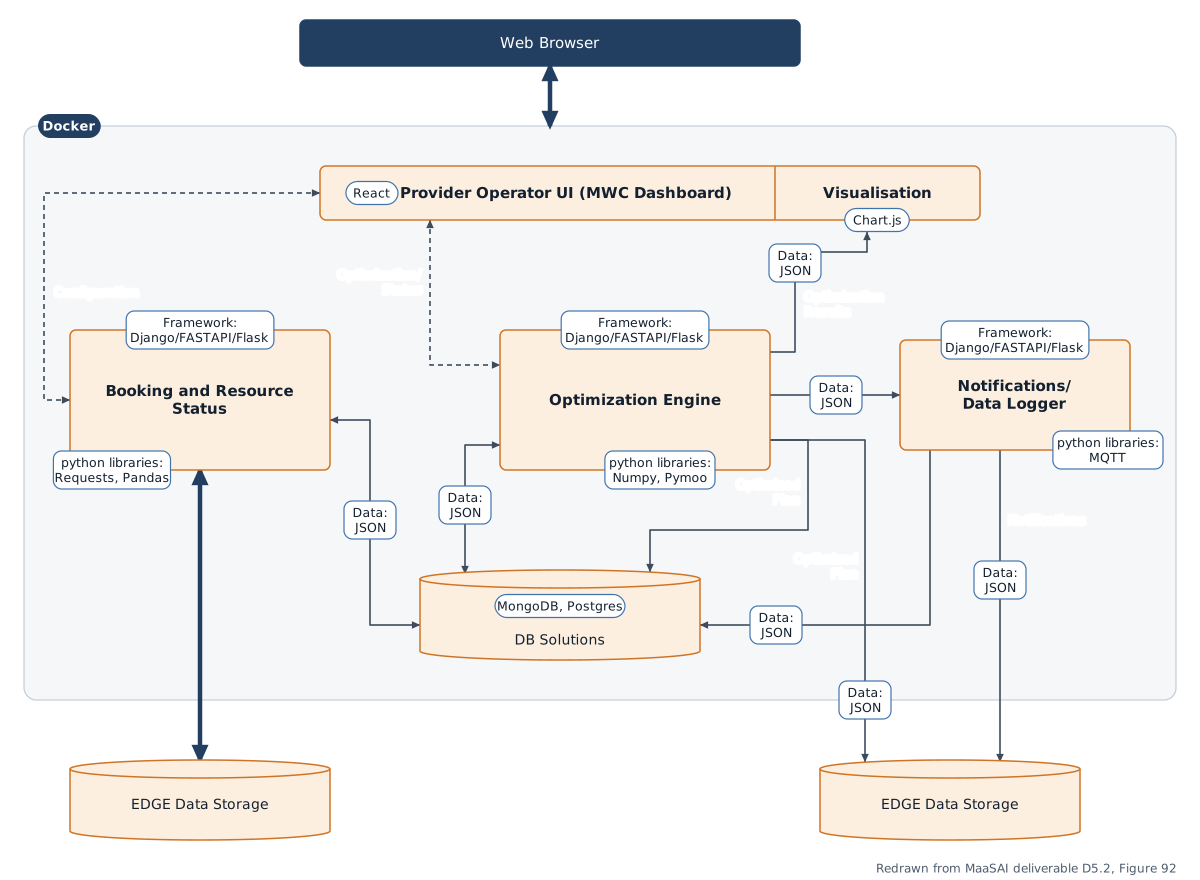
Architecture diagram redrawn from MaaSAI deliverable D5.2.
Technology Stack
Section titled “Technology Stack”MWC is a modular web-based decision-support component that keeps its core recommendation logic separate from the web application layer.
| Category | Technology |
|---|---|
| Frontend | Next.js/React with PrimeReact and PrimeFlex; Chart.js for configuration-run analytics |
| Backend | Python with Django and Django REST Framework, providing REST APIs, upload handling, persistence, and report export services |
| Core engine | the mwc_core Python package, performing job interpretation, family mapping, compatibility checking, baseline line assignment, recommendation generation, and evaluation |
| Data handling | pandas, openpyxl, and CSV utilities; Django ORM over a relational database (SQLite for local development, PostgreSQL for deployment) |
| Reports | CSV, JSON, and Excel exports |
| Containerisation | Docker / Docker Compose |
| Licence | no separate public licence has been defined; the component is developed within the MaaSAI research project, and redistribution should be confirmed with the consortium |
Integrations & External Dependencies
Section titled “Integrations & External Dependencies”The current baseline is self-contained, operating on structured input files and internal master-data tables derived from the BarbaStathis pilot modelling work. Required dependencies are PostgreSQL, Docker, and file/report storage; Keycloak is required for MaaSAI deployment (optional in local development) and an Nginx reverse proxy is recommended. Two MaaSAI integrations are planned rather than active: retrieval of job and booking information from the MaaS Booking services, and — where validated interfaces and data availability permit — consumption of resource or asset-state information from Digital Twin APIs.
APIs & Interfaces
Section titled “APIs & Interfaces”The backend exposes REST-style endpoints under /api/v1/.
/api/v1/health/— backend availability and baseline service information/api/v1/job-batches/validate/— upload and validate structured CSV/Excel job files;/api/v1/job-batches/for batch history and detail/api/v1/configuration-runs/— execute the baseline configuration workflow and retrieve completed runs, recommendations, and evaluation summaries/api/v1/reports/— generate and download CSV, JSON, and Excel reports- MaaS Booking input and Digital Twin resource-state endpoints are declared but still to be defined
The UI, accessed through the MaaSAI frontend, comprises a landing page, the configuration workspace (upload, validate, run, review), a run detail and analytics view with charts and advanced evaluation panels, report/export access, and history pages for job batches and configuration runs.
User Interface
Section titled “User Interface”Representative screens of the MWC web interface in the first release:
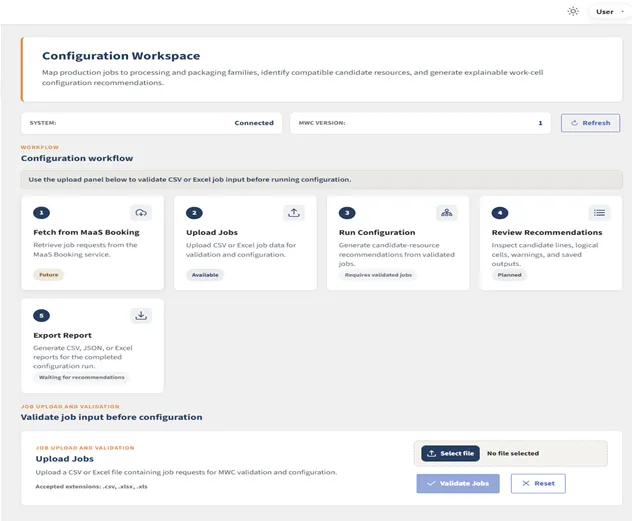
Configuration workspace — MaaSAI deliverable D10.1.
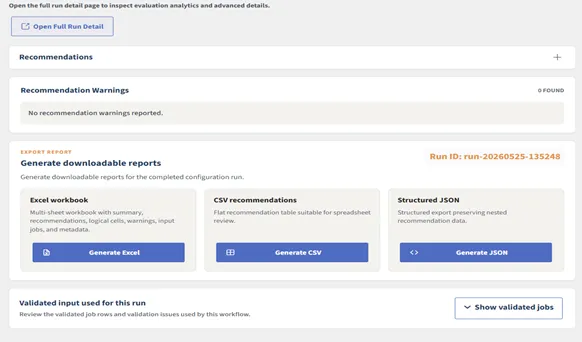
Report and export interface — MaaSAI deliverable D10.1.
Deployment & Configuration
Section titled “Deployment & Configuration”MWC is distributed as a pre-configured set of Docker Compose containers, currently deployed and tested within the MaaSAI frontend/backend development environment; the final production deployment profile remains to be confirmed.
| Requirement | Minimum | Recommended |
|---|---|---|
| CPU | 4 cores | 4–8 cores |
| RAM | 8 GB | 16 GB |
| Storage | 5–10 GB | 20+ GB |
| OS | — | Linux server |
The minimum profile requires Python 3.x and Node.js runtimes, with PostgreSQL recommended. Key configuration parameters include the database URL, product-catalogue and master-data paths, report output directory, the backend API URL used by the frontend, and Keycloak settings (realm URL, client ID, check-sso load mode); authentication can be disabled only in controlled local development.