
LCA-LCC Toolkit (LCT)
At a Glance
Section titled “At a Glance”
- Category: Planning, Design & Assessment
- Primary environment: MaaS Provider
- Documentation focus: Design reference
- Maturity: TRL 4, progressing towards TRL 5–6 (first release, reported in D12.1 at M20; MaaSAI System 1st Release planned for M24)
- Related architecture docs: Reference Architecture Guide, Environments
Purpose
Section titled “Purpose”The LCA-LCC Toolkit helps MaaSAI providers assess environmental and cost impact in a structured way. It combines lifecycle assessment and lifecycle costing so industrial decisions can be evaluated not only for feasibility, but also for sustainability and economic effect.
Primary Actors
Section titled “Primary Actors”The D5.2 usage viewpoint defines roles, permissions, constraints, a role-task matrix, and a use case diagram for this solution.
- LCA Analyst: Create, edit, and share studies Analyse and validate data with LCI data provider role Generate dashboards results and reports; constraint: Relies on datasets maintained by the admin role Cannot change account role
- LCI Data Provider (Pilot): Fill out LCI data in templates Review/download reports; constraint: Access is limited to shared studies created by others Can edit templates and review reports only with analyst permission LCA library is invisible to pilots Cannot change account role
- System Admin: Manage user accounts and roles Maintain system settings and datasets Ensure data confidentiality
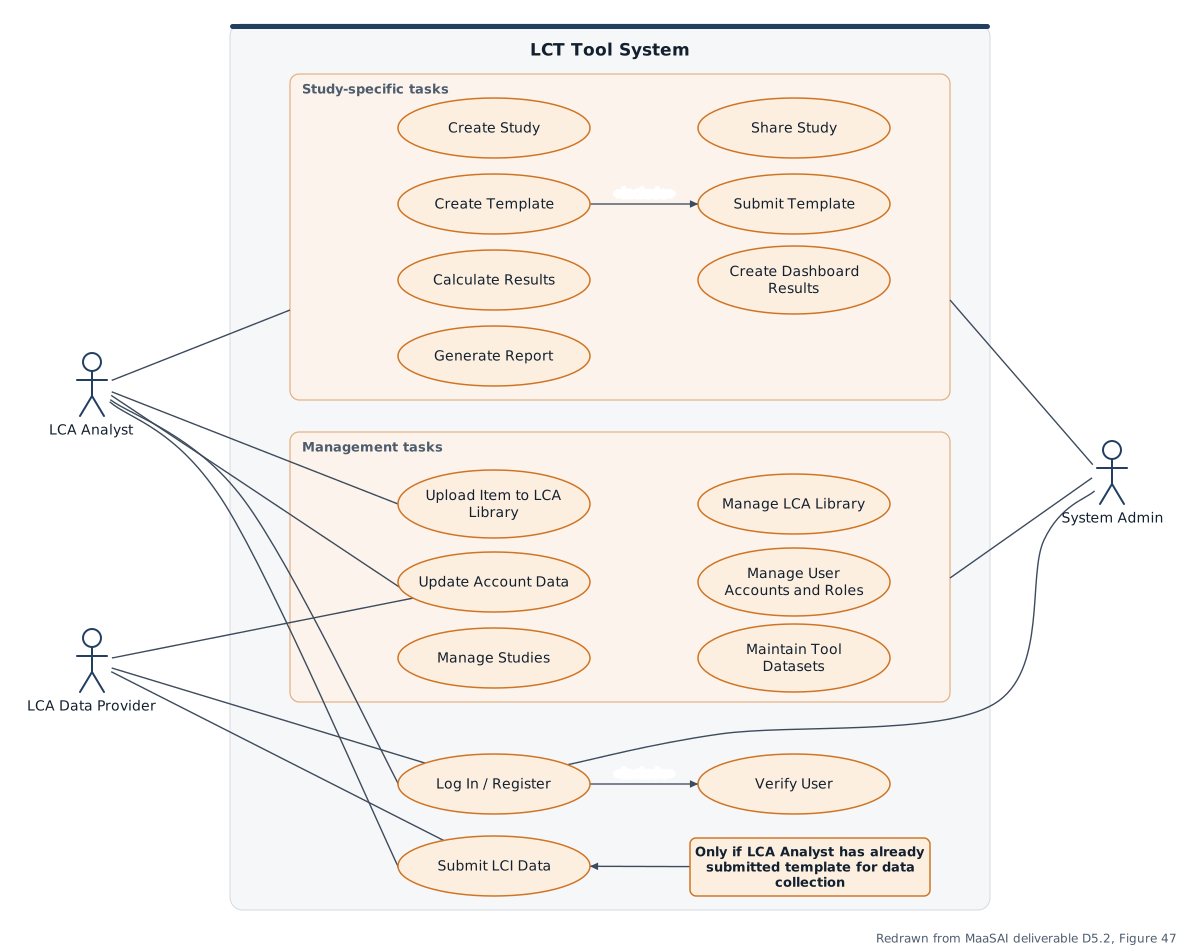
Use-case diagram redrawn from MaaSAI deliverable D5.2.
Functional Components
Section titled “Functional Components”LCT includes lifecycle libraries, data-collection templates, calculation services, dashboard generation, report generation, and ML-assisted insight services. The functional view clarifies how user input and lifecycle data are transformed into cost, impact, and reporting outputs.
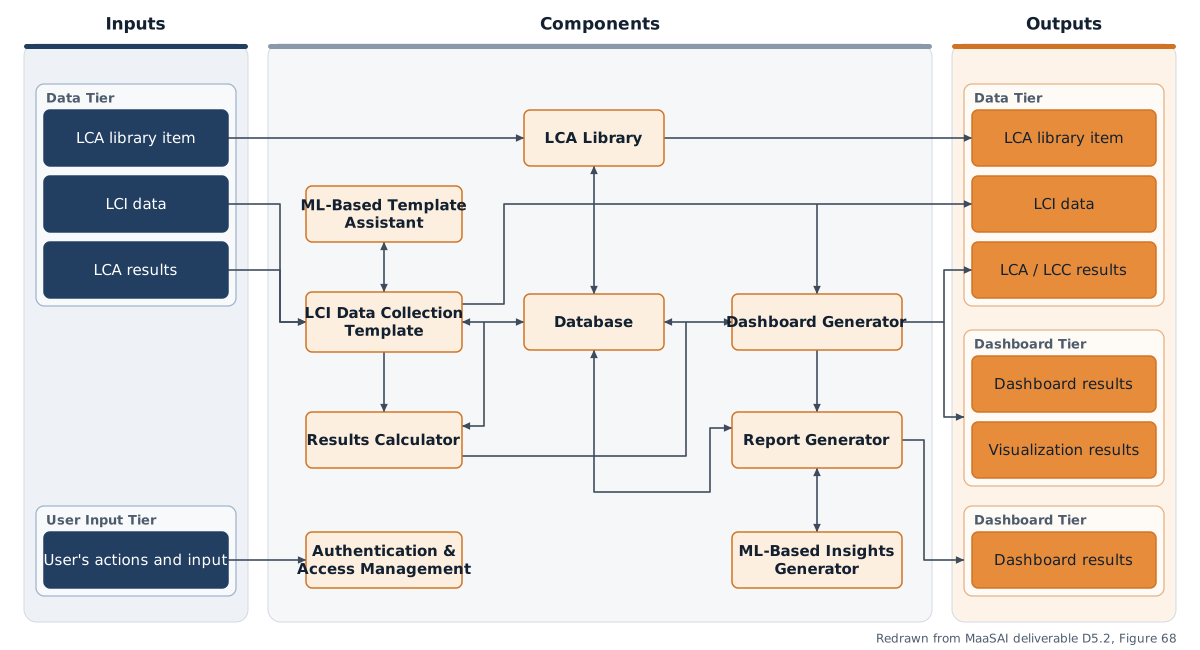
Functional components diagram redrawn from MaaSAI deliverable D5.2.
Design Baseline
Section titled “Design Baseline”The toolkit follows a modular structure with three core layers: a frontend for data entry and dashboards, a backend for business logic and coordination, and a database for persistent study and configuration data.
The frontend communicates with the backend through secured APIs and integrates with Keycloak for authentication and authorisation, ensuring that access to studies, datasets, and reports can be managed per role.
The backend also acts as the integration point with external LCA tools and internal MaaSAI services, which makes the toolkit easier to maintain and extend over time.
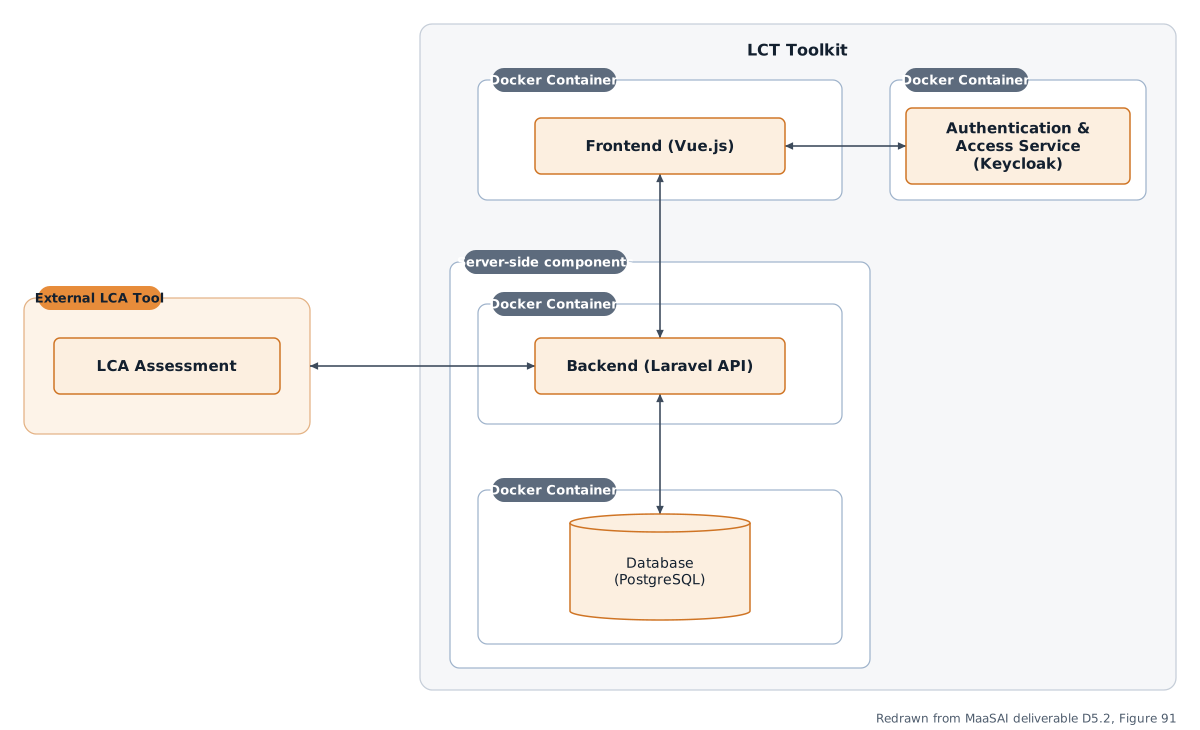
Architecture diagram redrawn from MaaSAI deliverable D5.2.
Technology Stack
Section titled “Technology Stack”The LCT follows a modular, component-oriented and containerised stack.
| Category | Technology |
|---|---|
| Frontend | Vue.js user interface |
| Backend | Laravel/PHP for application logic and API development |
| Data | PostgreSQL storing LCI data, studies, reports, library items and configuration |
| Identity | Keycloak for authentication, session handling and role-based access control |
| Interoperability | OpenLCA-compatible schema for data exchange with external LCA software |
| Containerisation | Docker for all components |
Integrations & External Dependencies
Section titled “Integrations & External Dependencies”The LCT’s main external integration is with OpenLCA: environmental LCA calculations are performed by exporting inventory data to OpenLCA and importing the assessment results back for visualisation, reporting and decision support, while LCC is calculated entirely within the toolkit. Required dependencies are PostgreSQL, Keycloak, Docker and OpenLCA (or an OpenLCA-compatible schema). Integration with the MaaSAI EDGE Data Storage (DS) is only under investigation as a low-priority roadmap item (M33), as is a connection to external LCA databases as LCI input (M30).
APIs & Interfaces
Section titled “APIs & Interfaces”The backend exposes a REST API organised in groups:
/api/studies— study management, including sharing, reports, product systems and dashboard results- Product systems within a study — CRUD plus LCC calculation, pilot workflow and OpenLCA export/import
- Processes and costs — process management with resources, investment, operational, end-of-life and external costs, and incomes
- Reports — PDF and Word download with a pilot review workflow (request, submit, cancel)
- Dashboard results — LCA/LCC dashboards per study with PDF export
/api/lcas— LCA library entries with OpenLCA-compatible file download- Supporting endpoints — notifications, read-only reference data, statistics, external cost factors, suggested studies
The Vue.js interface covers the study list and overview, study sharing (view/edit access), a four-step product-system progress tracker, a process flow diagram editor, the LCI editor for LCA and LCC data entry, guided calculation options, configurable dashboards, a rich-text report editor and a searchable LCA library. Three roles are supported: LCA Analyst, Pilot and System Admin.
User Interface
Section titled “User Interface”Representative screens of the LCT web interface in the first release:
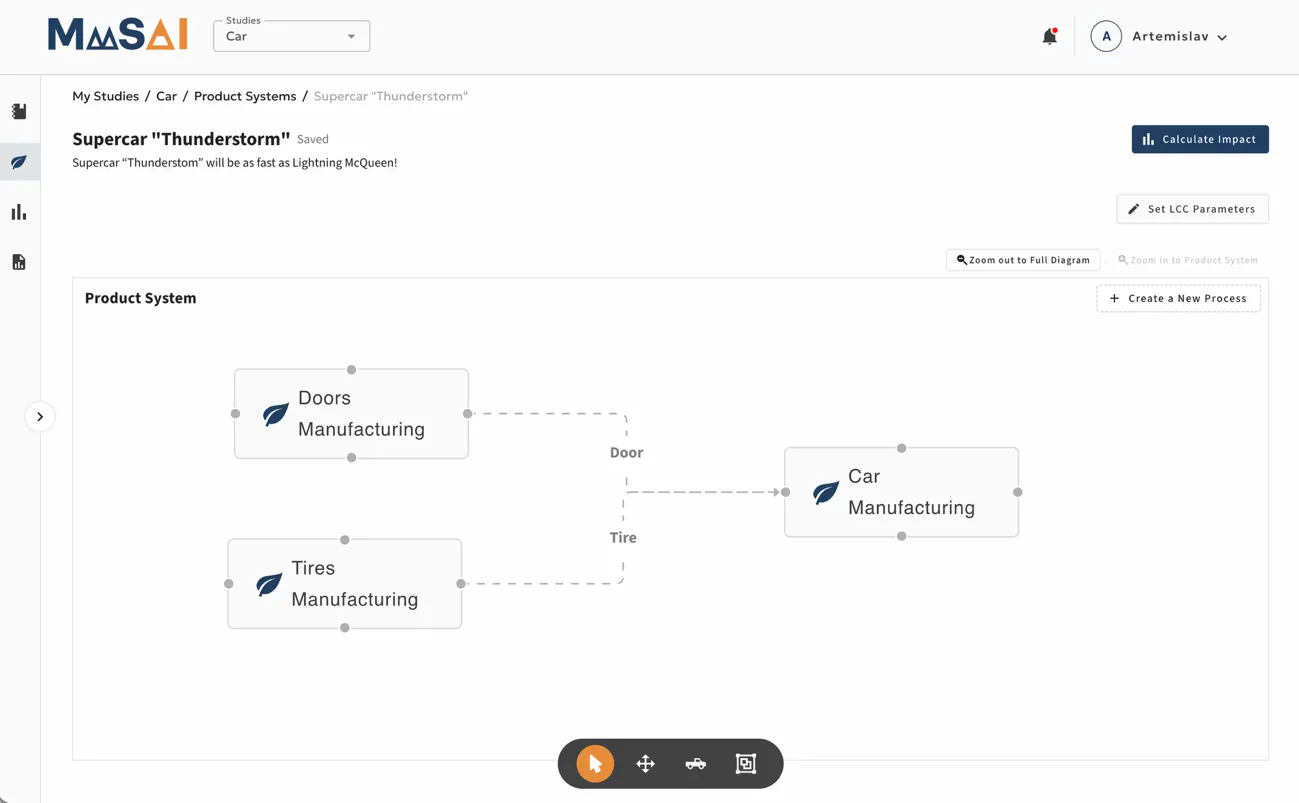
Process Flow Diagram — creating, editing and connecting processes — MaaSAI deliverable D12.1.
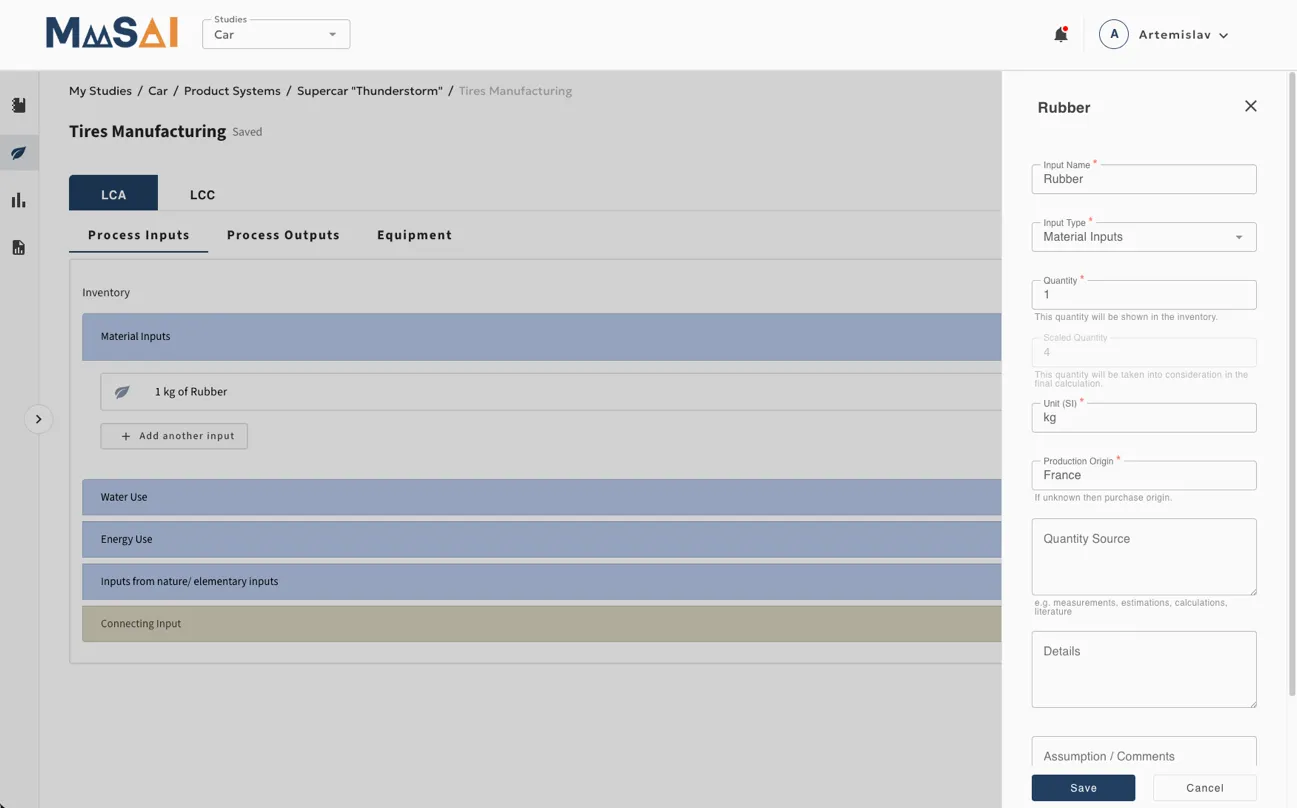
Life Cycle Inventory (LCI) Editor — MaaSAI deliverable D12.1.
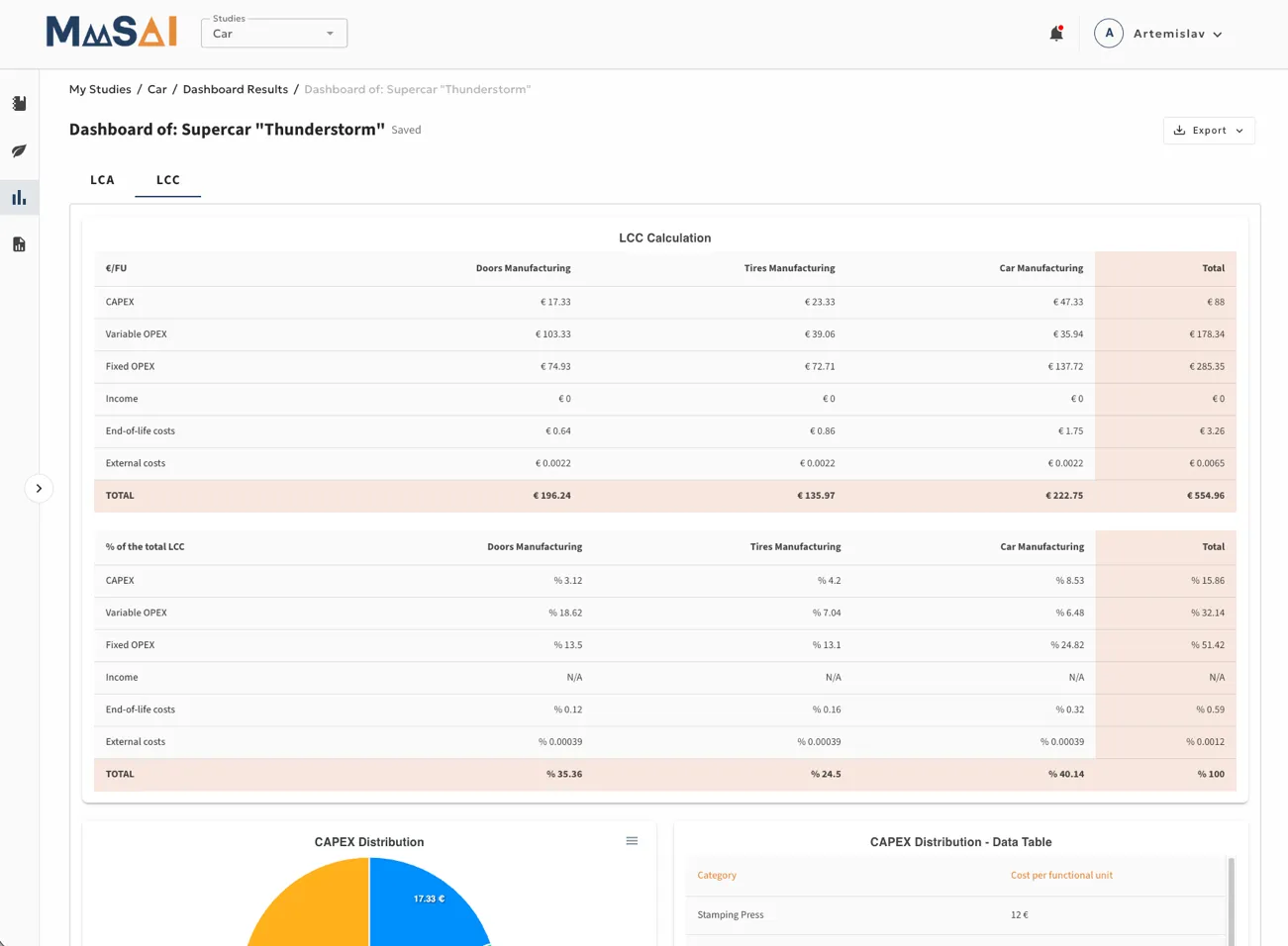
Dashboard — LCA (top) and LCC (bottom) assessment results — MaaSAI deliverable D12.1.
Deployment & Configuration
Section titled “Deployment & Configuration”Deployment is container-based, separating frontend, backend, database and identity management.
| Requirement | Minimum | Recommended |
|---|---|---|
| CPU | 2 cores | 4+ cores |
| RAM | 4 GB | 8 GB+ |
| Storage | 10 GB | 50 GB+ |
| OS | Linux (Ubuntu 22.04+) | Linux (Ubuntu 22.04+) |
Docker 24+ and Compose v2 are required. Networking uses the internal Docker bridge, with a load-balanced ingress or reverse proxy (e.g. Nginx, Traefik) recommended.